
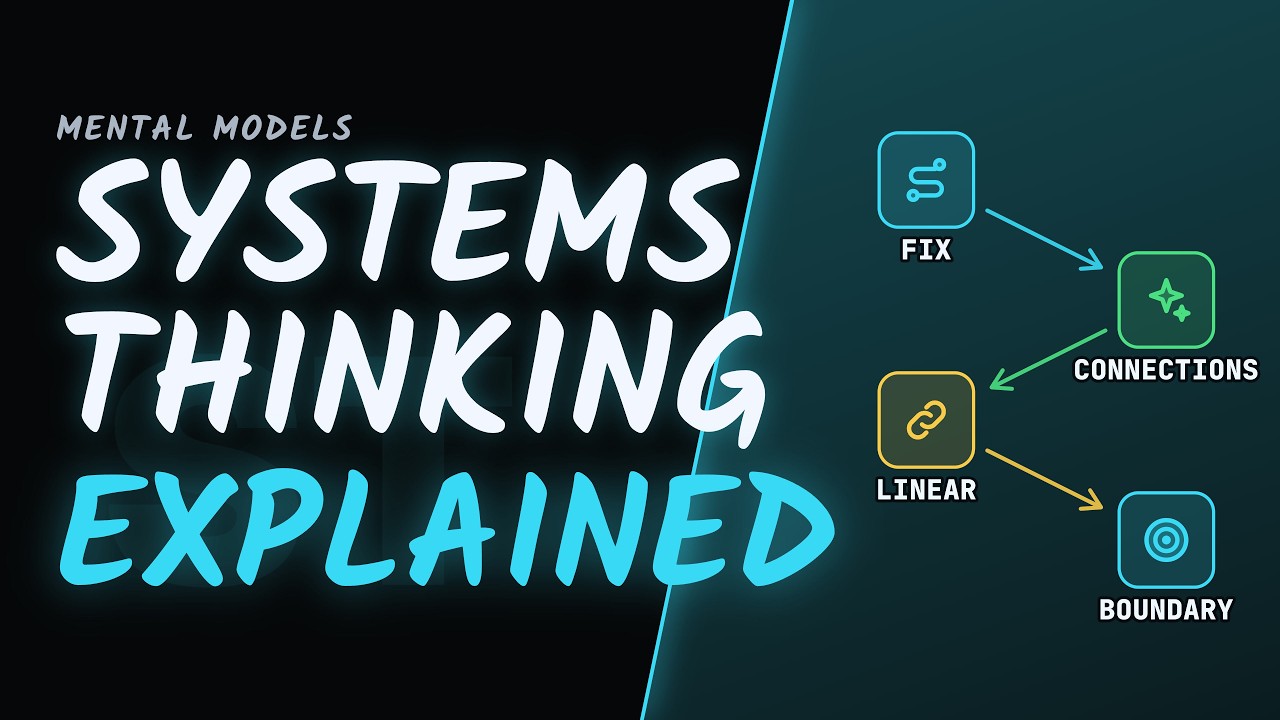
Systems thinking is a way of understanding a problem by studying how its parts connect and influence each other, instead of examining each part on its own. It explains why some well-meant fixes, like adding lanes to a busy road, can leave the original problem as bad as before or worse.
This guide walks through the core ideas in order: boundaries, stocks and flows, reinforcing and balancing feedback loops, delays, and leverage points. Along the way we follow one running example, the daily traffic jam, and finish with the three traps that catch even experienced practitioners.
- A system is a set of parts plus the connections that let them affect each other.
- Stocks accumulate over time; flows are the rates that fill or drain them.
- Reinforcing loops amplify change, while balancing loops pull a stock toward a goal.
- Delays cause overshoot, and leverage points show where a small change shifts the whole system.
- When a problem keeps returning, fix the structure, not the symptom.
- 0:00Intro
- 0:24When the fix makes it worse
- 1:18See the connections, not just parts
- 2:10Where linear thinking breaks down
- 2:55Define boundary, stocks and flows
- 3:50Reinforcing loops amplify change
- 4:36Balancing loops pull toward a goal
- 5:25Delays make systems overshoot
- 6:10Find the leverage points
- 7:01Why new lanes fill up again
- 7:36One lens, many fields
- 8:22Three traps to avoid
- 9:06What systems thinking gives you
- 9:32Ask what structure keeps producing it
Why do some fixes make the problem worse?
Consider a road that jams every rush hour. The obvious fix is to widen it. For a while, it works: drive times genuinely drop. Then something unexpected happens. Because driving is now faster and easier, more people choose to drive. They take trips they used to skip, move farther from work, or stop taking the bus. Before long, the new lanes are full and the jam is back.
The important lesson here is that nobody did anything wrong. The planners acted sensibly and the drivers made reasonable choices. The outcome was decided by the structure of the system, the way road speed, driver decisions and traffic volume feed into each other. Many fixes in cities, companies and personal life treat the symptom while leaving that structure untouched, which is why the problem returns. Systems thinking is the habit of looking at the structure first.
What is systems thinking?
The simplest definition to hold onto is this: a system is a set of parts, plus the connections that let those parts affect each other. Systems thinking studies those connections. It contrasts with a parts view, which examines the road, the cars and the drivers one at a time and asks which piece is broken.
A systems view asks a different question: what pattern do the links create? Road speed shapes driver choices, and those choices in turn shape road speed. A traffic jam is not located inside any single car. It emerges when many drivers respond to the same road at the same time. This is what people mean when they say behaviour emerges from interactions.
The practical consequence is encouraging. If behaviour comes from how the parts are wired together, then rewiring the connections changes the behaviour. That is why systems thinkers spend less effort repairing individual parts and more effort understanding and adjusting the links between them.
- Parts view: studies each piece alone and asks which part is broken.
- Systems view: studies interactions and asks what pattern the links produce.
Where linear cause-and-effect thinking breaks down
Our default mental habit is linear: A causes B, B causes C, and the story ends. That works well for simple machines, where pressing a button reliably produces a result. Real systems, however, do three things a straight line cannot capture.
First, they have delays, where effects show up long after the cause. Second, they have feedback, where an effect circles back and changes its own cause. Third, they produce side effects, unintended consequences that land somewhere you were not looking. In a real system, today's effect often becomes tomorrow's cause. Systems thinking exists to follow these loops rather than stopping at the first arrow, and to count the consequences that arrive later and elsewhere.
- Delays: the effect appears long after the action.
- Feedback: the effect loops back to change the cause.
- Side effects: consequences land outside your focus.
Boundaries, stocks and flows: the bathtub model
The first step in mapping a system is deciding what you are looking at. That starts with the boundary: what counts as inside the system and what sits outside it. For traffic, does your map include buses, housing and jobs, or only the road itself? The choice matters, because causes outside the boundary become invisible.
Next come stocks and flows, best pictured as a bathtub. The water in the tub is the stock. The tap and the drain are the flows. A stock is anything that accumulates over time, such as water, money, cars on a road, or trust within a team. Crucially, a stock changes only through its flows.
Applied to traffic, trips starting are the inflow, adding cars. The number of cars on the road right now is the stock. Trips ending are the outflow, draining it. The bathtub rule is simple: if inflow exceeds outflow, the stock rises. That single rule explains why a jam builds up during rush hour.
Reinforcing and balancing feedback loops
Once you have stocks and flows, the next step is mapping how they loop back on each other. A reinforcing loop is a chain where a change feeds itself, so the stock keeps moving in the same direction. Think of an app growing by word of mouth: more users bring more referrals, more referrals bring more sign-ups, and more sign-ups mean more users, a little bigger each lap.
Reinforcing loops amplify. They produce snowballs, runaway growth and vicious circles. They also run in both directions. The same structure can drive a collapse: fewer users, fewer referrals, fewer sign-ups. A bank run follows exactly this shape.
Balancing loops are the counterweight. They push a stock back toward a target. Each has a goal, a way to measure the gap from that goal, and an action that shrinks the gap. A thermostat compares room temperature to its setting and runs the heater until the gap closes. The same logic explains how your body holds its temperature and how shelves get restocked.
Balancing loops resist change, and traffic has one. As jams grow, driving becomes less appealing, so fewer people drive. When new lanes ease the jams, that brake lifts, driving becomes attractive again, and the lanes refill.
- Reinforcing loop: more leads to more, or less leads to less.
- Balancing loop: measure the gap, act to close it, measure again.
How delays make systems overshoot
The third step adds time. A delay is the gap between an action and the moment you finally see its effect. Delays are where good intentions most often turn into wild swings, because people react to old information.
The hotel shower with long pipes is a familiar example. You turn the tap hotter, but the water stays cold because the warm water has not arrived yet. So you turn it hotter again. Then both adjustments arrive together and the water is scalding. You turn it colder, and the cycle starts over. This back-and-forth is called overshoot and oscillation.
The remedy is to act smaller and wait longer, or to shorten the delay itself. Road building involves long delays between construction and the change in driving habits, which is one reason the traffic rebound so often surprises planners.
What are leverage points in a system?
If delays tell you where to be patient, leverage points tell you where to push. A leverage point is a place where a small change shifts how the whole system behaves. The catch is that leverage points are often not where the symptom appears.
Peak pricing is a traffic example. Charging a little more to drive at rush hour leads some people to shift their travel times or routes. The result is fewer peak trips and steadier flow, without pouring any new concrete.
It helps to distinguish two kinds of intervention. Low-leverage changes tweak numbers inside the same structure, like adding one more lane, and the loops quietly cancel the effort. High-leverage changes alter the rules, the goals, or who gets what information, which reshapes the loops themselves. Good places to look are the strength of a loop's feedback and the length of its delays.
- Low leverage: adjusting quantities within the existing structure.
- High leverage: changing rules, goals or information flows.
- Where to look: loop strength and delay length.
Why new road lanes fill up again: induced demand
Putting every step together, the road story becomes clear. Transport researchers have documented this pattern for decades and call it induced demand. A planner sees jams and adds two lanes. The wider road delivers faster trips at first. Faster trips attract more driving: new journeys, longer commutes, and people leaving transit. After a delay, the jams return.
A better fix works on the structure rather than feeding the loop. Frequent public transit, peak-time pricing, or housing closer to jobs each change how the loop runs. Instead of making driving easier until the balancing brake disappears, they change the choices available to people.
Where systems thinking is used, and common mistakes
Once you have seen these structures on a road, you start spotting them everywhere. In ecology, predator and prey populations form linked loops. In public health, infections spread through a reinforcing loop. In supply chains, ordering delays cause stock swings. In urban planning, roads, housing and transit shape each other. In organisations, workload, burnout and hiring loop together. Learn a loop once and you will recognise it in an epidemic, a viral product, or a team's downward spiral.
Even people who know the tools fall into three traps. The first is a narrow boundary, drawing the system too small, such as studying the road without housing or transit. The fix is to ask what lies just outside your map. The second is ignoring delays, judging a change too early and then overcorrecting like the shower. Ask how long the effect really takes to appear.
The third trap is blaming people instead of structure. A common thought is that the problem would vanish if people just tried harder. But if you replace the people and get the same result, the structure is the cause. Ask what incentives, rules and information made that choice look sensible at the time.
- Narrow boundary: ask what lies just outside your map.
- Ignoring delays: ask how long the effect takes to show.
- Blaming people: ask what made the choice seem sensible.
Key takeaways
- A system is parts plus their connections; behaviour emerges from the links.
- Start by mapping the boundary, the stocks and the flows.
- Reinforcing loops amplify change; balancing loops seek a goal.
- Delays cause overshoot, so act gently and wait for feedback.
- Leverage comes from changing rules, goals and information, not just quantities.
- Before fixing a problem, ask what structure keeps producing it.
Frequently asked questions
What is systems thinking in simple terms?
Systems thinking is a way of understanding problems by looking at how parts connect and affect each other, rather than studying each part in isolation. It focuses on the structure, such as stocks, flows and feedback loops, that produces recurring behaviour.
What is the difference between a stock and a flow?
A stock is something that accumulates over time, like water in a bathtub, money in an account or cars on a road. A flow is the rate that fills or drains a stock, like the tap and the drain. A stock can only change through its flows.
What is the difference between reinforcing and balancing loops?
A reinforcing loop feeds itself, so change keeps building in the same direction, as with word-of-mouth growth or a bank run. A balancing loop works toward a goal by measuring a gap and acting to close it, as a thermostat does with room temperature.
Why does adding road lanes not fix traffic?
Wider roads make trips faster at first, which makes driving more attractive. People drive more, travel farther or leave transit, and after a delay the lanes fill up again. Transport researchers call this induced demand.
What is a leverage point?
A leverage point is a place in a system where a small change shifts the behaviour of the whole system. High-leverage changes usually alter rules, goals or information flows, or the strength of feedback and the length of delays.
What are common mistakes in systems thinking?
Three common traps are drawing the system boundary too narrowly, ignoring delays and overcorrecting, and blaming individuals instead of the structure around them. Each can be avoided by asking a simple question about what lies outside the map, how long effects take, or what made a choice seem sensible.
